


Want to sell a rare Picasso ceramic or find a distinctive work for your collection? Explore rare Picasso ceramics for sale and documented small Madoura editions. Contact our gallery to discuss acquisition opportunities or request a free, confidential evaluation of a ceramic you own.
Enquire About Rare Picasso Ceramics
Rare Picasso Ceramics for Sale: Documented Small Editions
The examples below were produced in documented editions of 25 or 50. These figures provide a concrete starting point for discussing production, but they do not establish how many examples survive or how often a work becomes available.
Select an artwork image to view its listing at Masterworks Fine Art. Contact our gallery to confirm current availability, request documentation and discuss the individual ceramic.
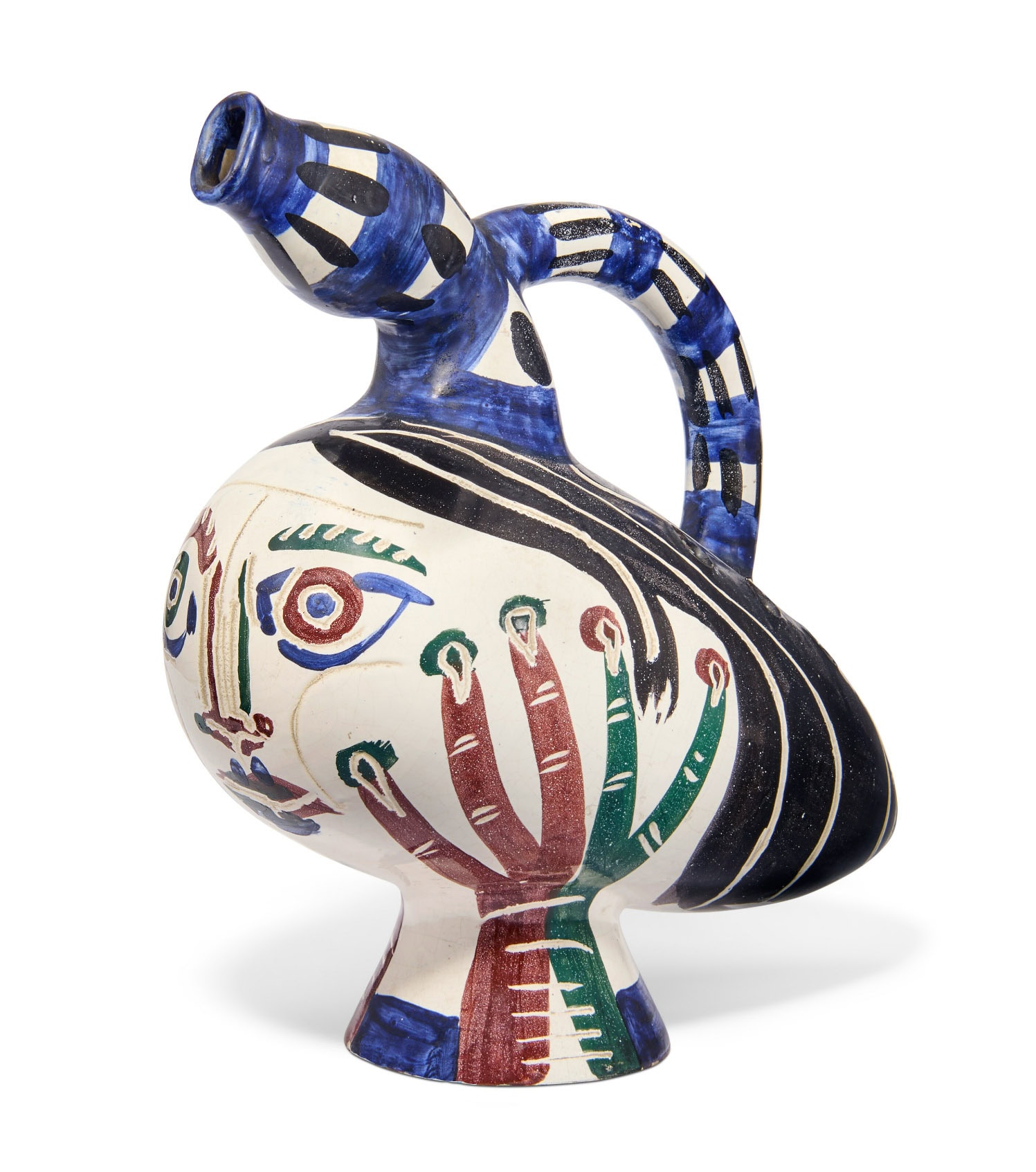
Canard pique-fleurs (Duck Flower-Holder), 1951
A.R. 117
Sculptural earthenware flower-holder
Documented edition: 50
Dimensions: 42.5 × 21.5 cm
Personnages et têtes (Figures and Heads), 1954
A.R. 242
Square-sided red earthenware vase
Documented edition: 25
Dimensions: 55.5 × 25.5 cm

Grande Tête de Femme au Chapeau Orné (Woman’s Big Head with Decked Hat), 1964
A.R. 518
Red earthenware portrait plaque
Documented edition: 50
Ceramic dimensions: 60.2 × 50 cm

What Makes a Picasso Ceramic Rare?
A useful description of rarity should explain the evidence for the particular work. Collectors can distinguish between:
- Documented edition size: the edition recorded for that design, checked against the catalogue and the individual ceramic.
- A documented unique work: a ceramic supported by research establishing its status as a one-of-a-kind object.
- A documented variant: a specific variation supported by appropriate catalogue or scholarly information.
- Availability: how often comparable examples have appeared in documented sales or other verifiable market records.
An unfamiliar title, unusual appearance or high asking price does not establish rarity on its own. Likewise, a small edition should be considered alongside condition, provenance and the quality of the individual ceramic.
Edition Number and Edition Size
The number assigned to an individual ceramic should be distinguished from the size of its edition. For example, a marking such as 20/25 identifies an example numbered within an edition of 25; it does not state how many examples remain in existence.
Ask how any artist’s proofs, publisher’s examples or other special designations are accounted for in the supporting documentation. A numbered edition is also different from a documented unique work.
Research and Documentation Before Purchase
Begin with the exact title, date, A.R. reference, form, dimensions and edition information. The three designs illustrated above are documented in Alain Ramié’s catalogue of Picasso’s edited ceramic works.
Request photographs from several angles, including the underside or reverse, together with a condition report and available provenance. If a work is described as a unique ceramic or special variant, ask for the specific evidence supporting that description.
Our Picasso ceramic identification guide explains the information that can help establish what you own.
Rarity and Market Value
Scarcity is one part of an evaluation. Condition, restoration, provenance, subject, form and recent comparable sales also matter. A smaller edition does not automatically make one ceramic more valuable than a work from a larger edition.
Compare the documented characteristics of the individual ceramic rather than relying on the word “rare.” Read our Picasso ceramic value guide or contact our gallery to discuss a particular work.
Sell a Rare Picasso Madoura Ceramic
Send photographs of the entire ceramic, its underside or reverse, signatures, stamps, edition numbers and any condition issues. Include measurements and any invoices, certificates, ownership records or research supporting its identification.
You do not need to establish rarity before contacting us. We review the available information and, if the ceramic is suitable for our inventory, may make a confidential, no-obligation direct purchase offer. Learn more about selling Picasso ceramics.
Buying or selling a Picasso Madoura ceramic? Contact our gallery or call (415) 335-7479.