


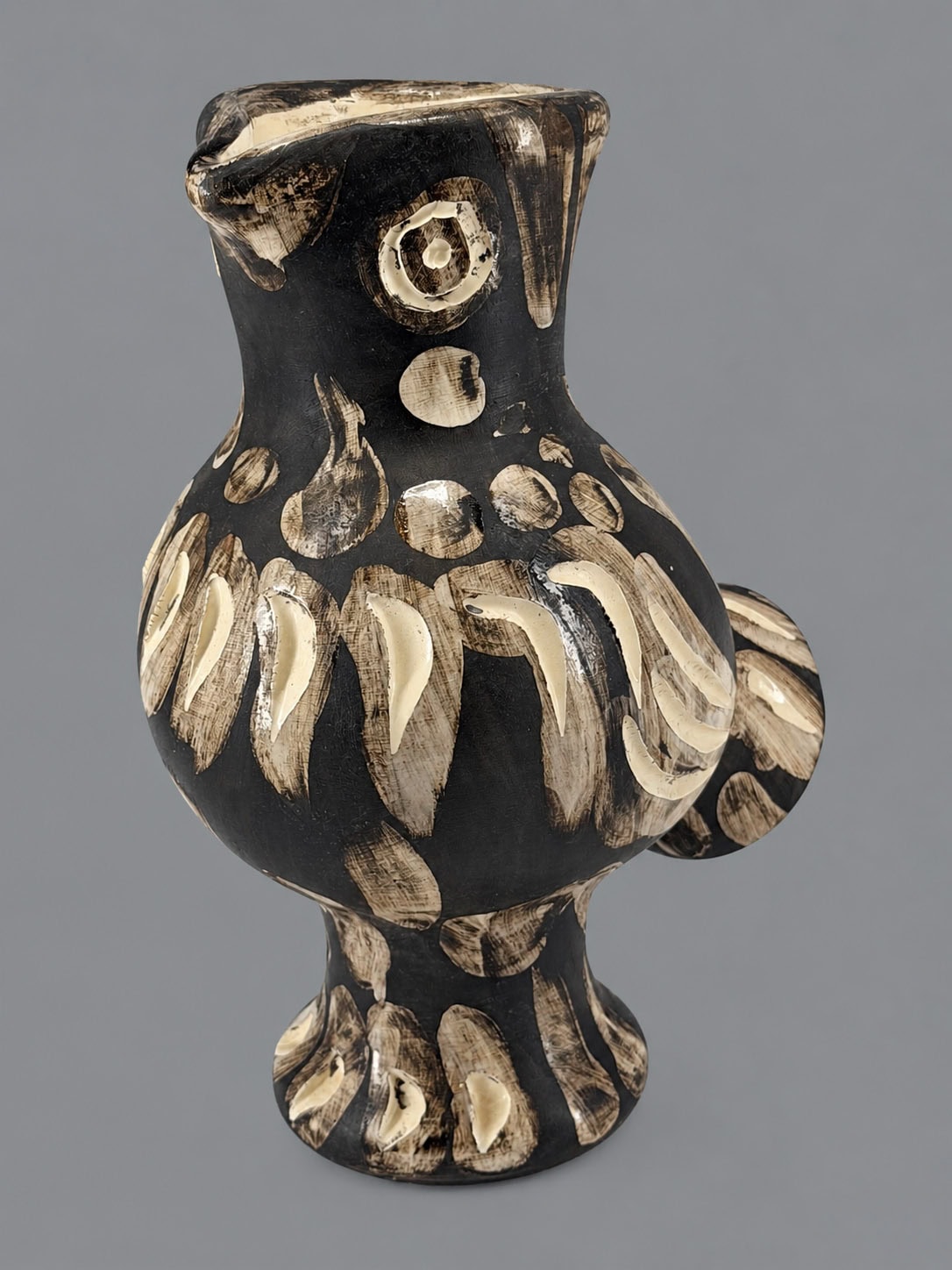
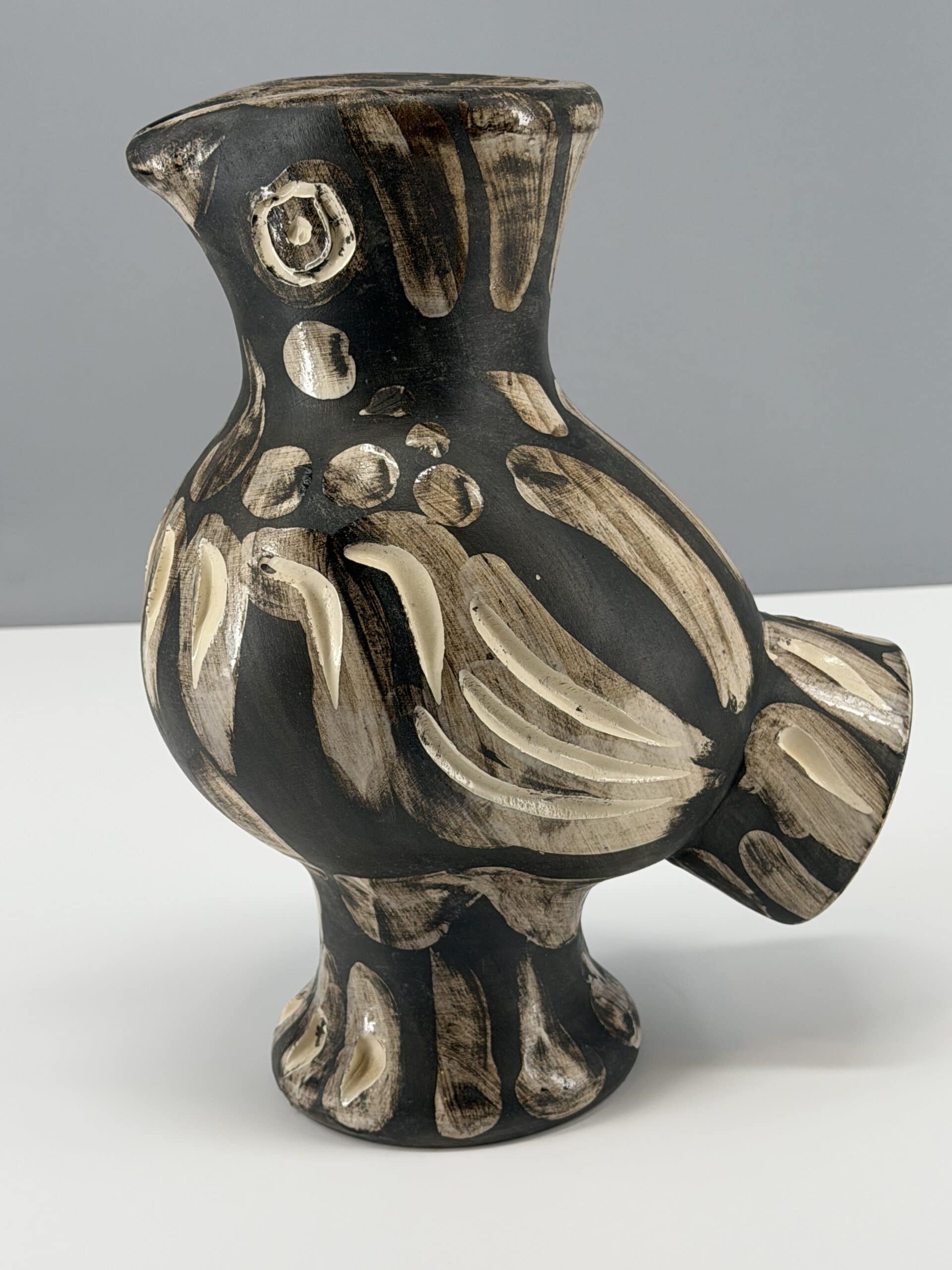
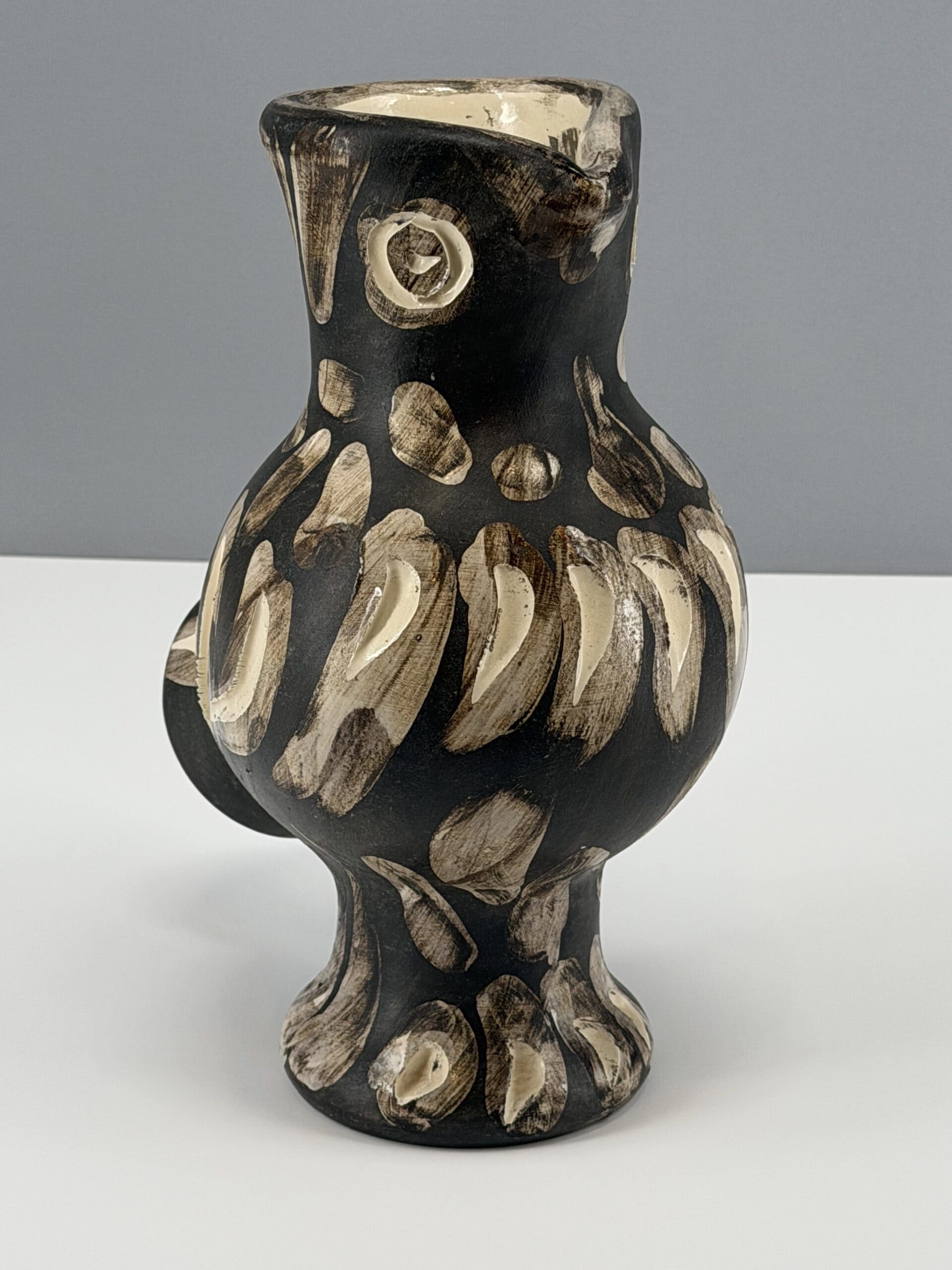
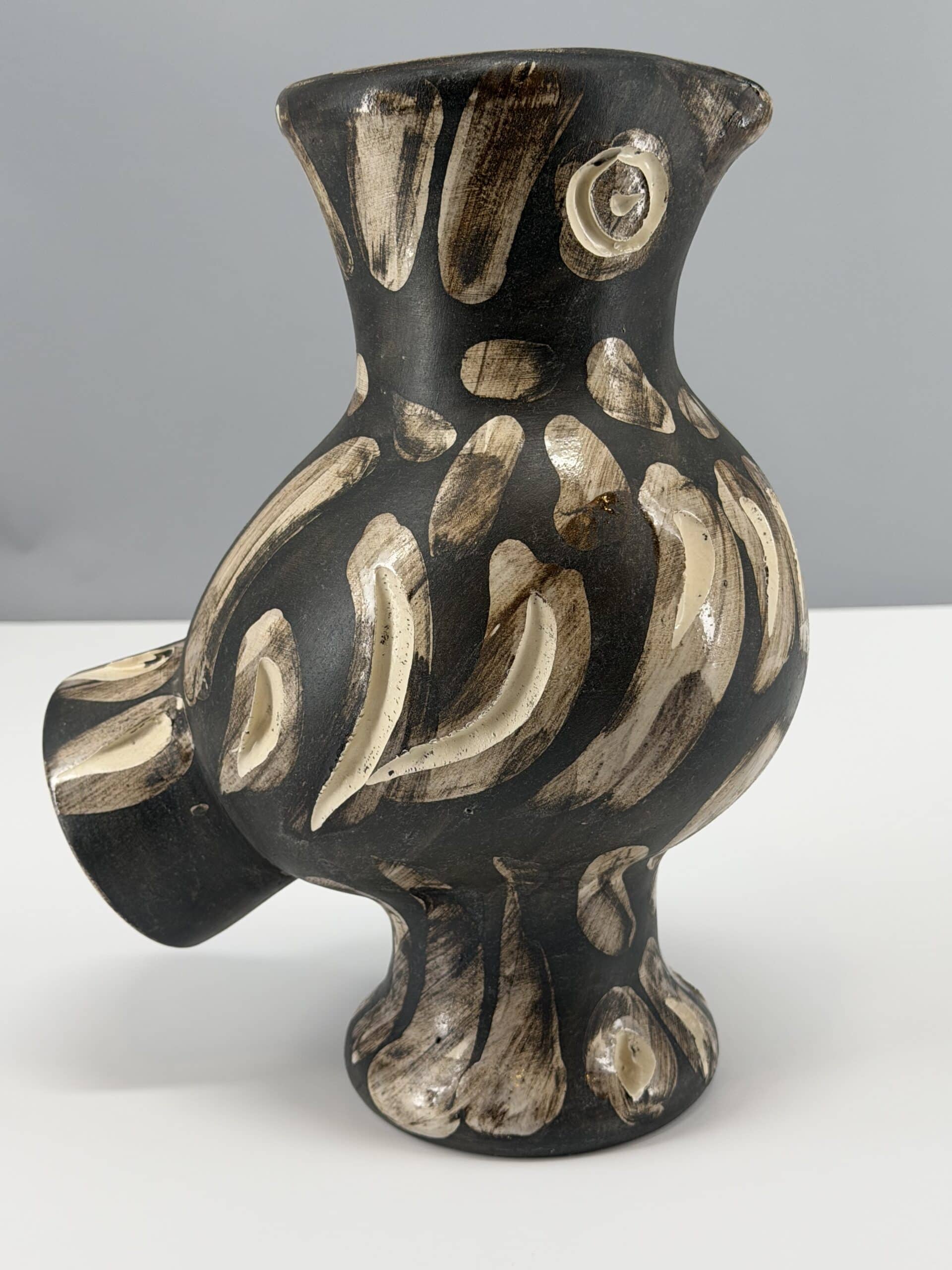
Chouette (Wood-Owl), 1969
Select a photograph to enlarge it.
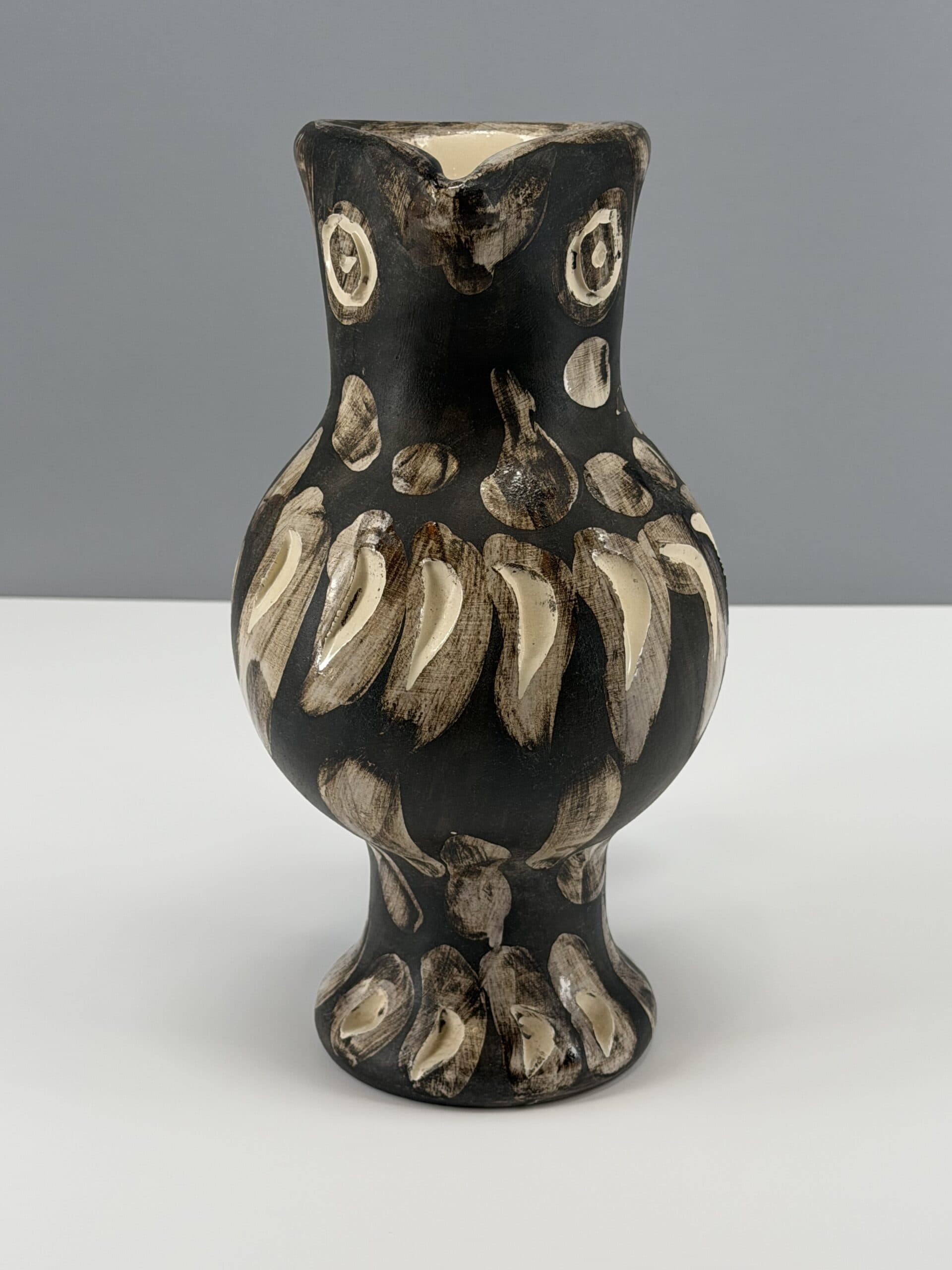
USD 38,000.00
- Artist
- Pablo Picasso
- Inventory number
- W-5513
- Catalogue reference
- Ramié 605
- Date
- 1969
- Medium
- Madoura turned vase of white earthenware clay with engobe decoration (brown, black) engraved by boring-rod under partial brushed glaze with black patina
- Dimensions
- 11 1/2 in x 8 7/8 in (29.4 cm x 22.5 cm)
- Edition
- Numbered from the edition of 500
- Signatures & markings
- This work is stamped with the 'MADOURA PLEIN FEU' and 'EDITION PICASSO' pottery stamps on the underside, along with the handwritten inscription'EDITION PICASSO MADOURA' in black.
- Condition
- This work is in excellent condition.
About This Ceramic
Pablo Picasso’s Chouette (Wood-Owl), 1969 is a wonderfully expressive ceramic that transforms the familiar form of a turned vase into one of Picasso’s most beloved and personally meaningful animal subjects.
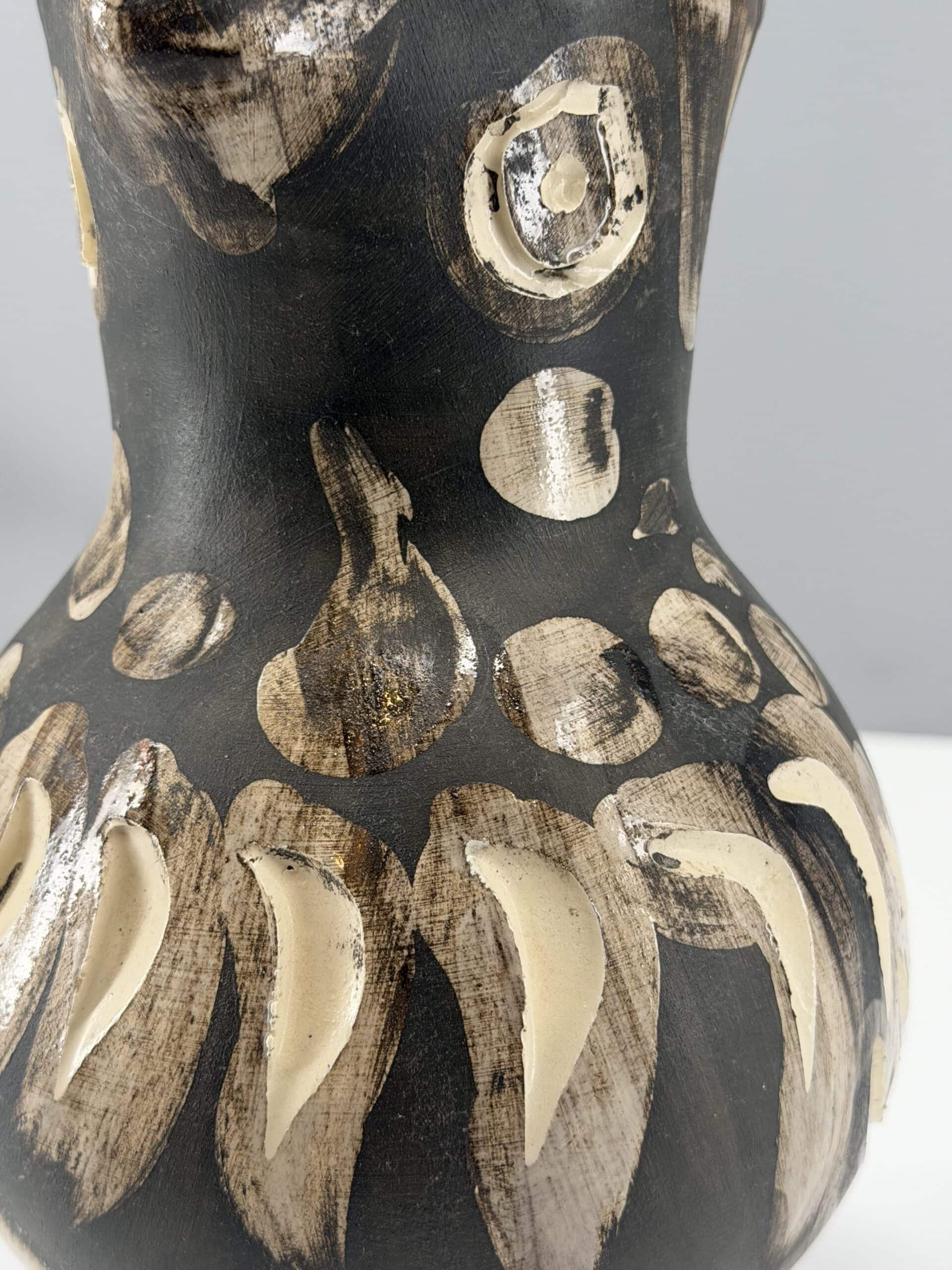
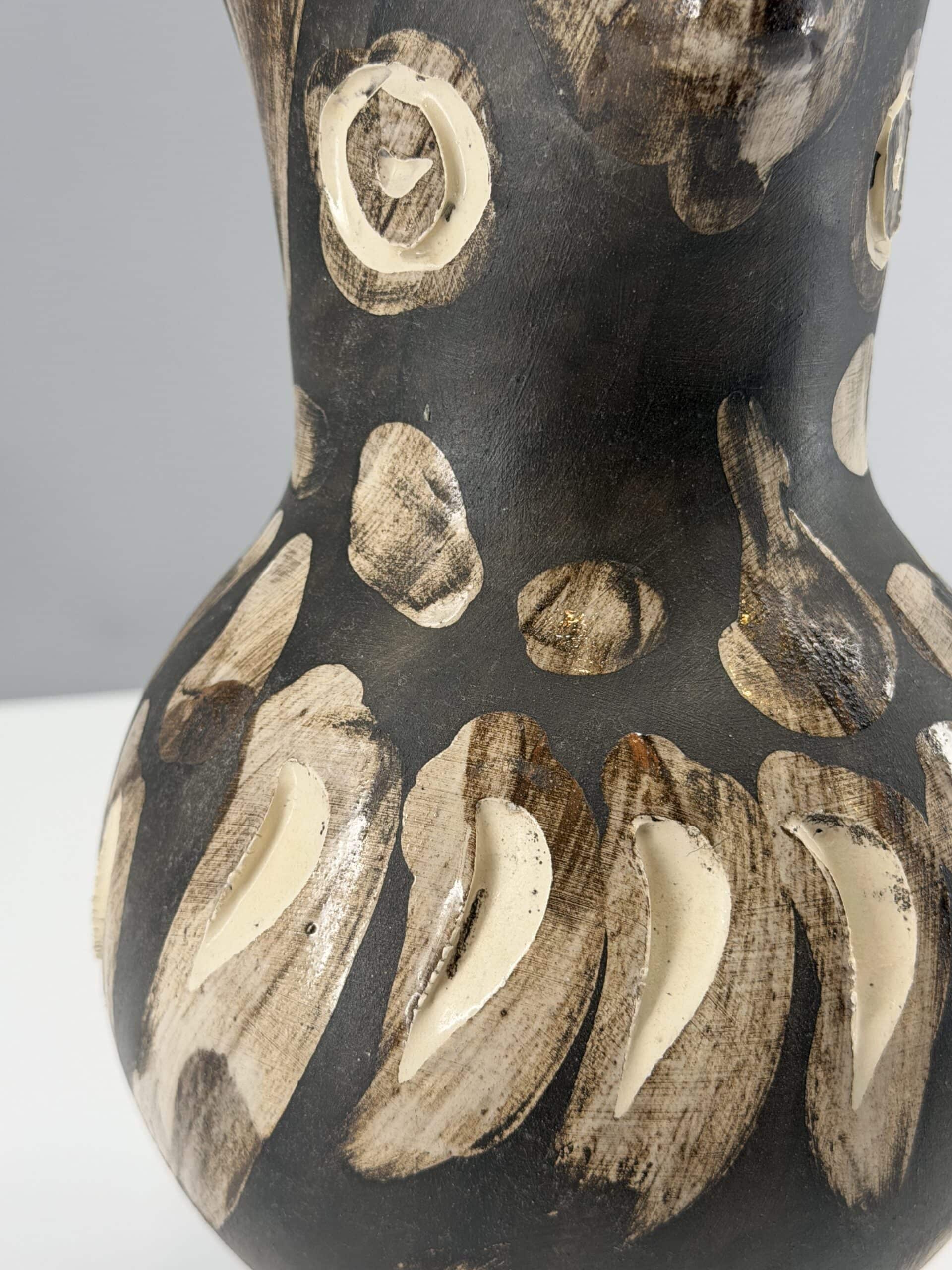
The owl emerges almost effortlessly from the vessel itself: the swelling body of the vase becomes the bird’s rounded chest, the narrowed neck forms its head, and the irregular upper rim creates a heavy brow that gives the creature its wonderfully intense expression. A prominent circular eye immediately commands attention, while the deep black surface is animated by cream, brown, and earthy brushstrokes that suggest plumage without describing individual feathers literally. Across the chest, Picasso builds a rhythmic arrangement of broad feather-like forms, alternating brushed passages with lighter raised and glazed areas that give the surface remarkable physical variety. Smaller rounded marks climb toward the owl’s face, while additional feather motifs continue downward onto the foot, visually integrating the entire vessel into the anatomy of the bird. The rounded projection at the side becomes part of the owl’s body while preserving the object’s identity as a ceramic vessel. Particularly compelling is the contrast between the deep black patina and the warmer cream and brown decoration. Picasso needs very little color to create an enormous amount of character. The owl appears alert, proud, slightly eccentric, and almost comically serious, yet the economy of Picasso’s forms gives it an unexpectedly timeless quality. It is simultaneously vessel and sculpture, bird and abstraction—an exceptional example of Picasso’s ability to look at an ordinary object and discover an entirely different creature already contained within it.
The ceramic medium is particularly important to Chouette (Wood-Owl) because Picasso does not simply decorate the surface of a preexisting vessel; he uses the physical architecture of the ceramic as an essential part of the image. The work is a Madoura turned vase of white earthenware clay with brown and black engobe decoration, engraved by boring-rod beneath a partial brushed glaze with black patina. The dark surface establishes the owl’s body, while sweeping brushed passages and engraved details create feathers, facial features, and areas of texture. Some markings appear broad and spontaneous, retaining the immediacy of Picasso’s drawing and painting, while others are deliberately incised or articulated into the clay. The interaction between painted decoration, engraving, glaze, patina, and the underlying three-dimensional form means that the owl changes as the viewer moves around it. The vase’s neck becomes the owl’s head, its swelling body becomes the bird’s chest, and the foot becomes the creature’s feathered base. Rather than treating ceramics as simply another surface upon which to reproduce an image, Picasso exploits qualities unique to clay—the curvature of the vessel, its volume, tactile surface, and the unpredictable effects of glazing and firing—to create an object that functions simultaneously as image and sculpture.
Imagine living with Picasso’s Chouette (Wood-Owl) every day. Few objects combine this much personality with such an understated palette. From across a room, the owl’s rounded silhouette, deep black surface, and piercing circular eye give it an immediate sculptural presence; as you move closer, the experience becomes much more intimate. The apparently simple feather patterns begin to reveal individual brushstrokes, engraved passages, variations in glaze, irregular edges, and subtle transitions between cream, brown, and black. Depending on the angle from which it is viewed, the ceramic can appear proud and imposing, curious and humorous, or almost contemplative. That changing personality makes Chouette especially enjoyable to live with. It could sit beautifully on a pedestal, console, bookshelf, or cabinet, where its earthy palette would work naturally with wood, stone, linen, and other organic materials, while its bold graphic qualities would be equally effective in a highly contemporary interior. Unlike an artwork experienced primarily from one fixed viewpoint, this is an object that invites you to walk around it, notice the curve of the body, discover the decoration continuing around the surface, and encounter the owl differently throughout the day. It has the wit and spontaneity associated with Picasso but also the warmth and tactile appeal of something made from clay and fire—a work capable of becoming a familiar and distinctive personality within a home.
The owl also had a particularly personal meaning in Picasso’s life. In 1946, while Picasso was working at the Musée d’Antibes, housed in the Château Grimaldi in Antibes, artist and photographer Michel Sima brought Picasso and Françoise Gilot a small owl that had been discovered with an injured claw. Picasso and Gilot cared for the bird, bandaging its injured claw until it gradually healed. When they returned to Paris, they brought the owl with them, where it joined the canaries, pigeons, and turtledoves already in the household. Gilot later recalled the owl as an irritable and fiercely independent creature, yet Picasso became fascinated by its personality and appearance. Its enormous eyes, compact body, nocturnal character, and expressive temperament provided exactly the combination of recognizable form and unusual personality that repeatedly attracted Picasso to animals as artistic subjects.
This encounter helped transform the owl into a recurring presence within Picasso’s art. He depicted the bird repeatedly, and owls subsequently appeared throughout his paintings, drawings, prints, sculptures, and especially ceramics. The subject also carried deeper cultural associations that would have resonated with Picasso’s lifelong engagement with Mediterranean history and mythology. The owl was traditionally associated with Athena, the Greek goddess of wisdom and craft, while the bird could also suggest night, mystery, vigilance, omens, and the unseen world. Picasso never confined the owl to a single symbolic meaning. Depending on the work, it could appear wise, watchful, humorous, threatening, vulnerable, or strangely human. In Chouette (Wood-Owl), several of these identities seem to coexist. The enormous staring eye and dark body give the bird a vigilant, almost ancient presence, while its inflated chest, irregular feathers, and eccentric expression introduce unmistakable humor and individuality. Knowing Picasso’s personal history with the owl makes the ceramic especially engaging: this was not merely an attractive animal motif but a creature he had actually lived with, observed, cared for, and repeatedly reinvented through his art.
Picasso’s involvement with ceramics was equally personal and far more extensive than a brief experiment late in his career. His decisive encounter with the medium came in 1946, when he visited Vallauris in the South of France and met Suzanne and Georges Ramié, the potters who owned the Madoura workshop. Picasso experimented with ceramic objects during this initial encounter and returned to Madoura the following year. Ceramics and Vallauris soon became central to his artistic production, providing an environment in which he could work intensively with clay while drawing upon the long ceramic traditions of the Mediterranean.
What fascinated Picasso was not simply the possibility of transferring his familiar drawings onto ceramic surfaces. He immersed himself in the physical possibilities of the medium, experimenting with modeling, engraving, painting, slips and engobes, glazing, firing, and the transformation of traditional pottery forms. The inherent unpredictability of ceramics—the way pigments, glazes, earth, and fire could alter an object during firing—offered precisely the kind of experimentation that had driven Picasso throughout his career. He could treat a plate as a face, transform the curves of a pitcher into a woman’s body, convert handles into arms or wings, or recognize an animal within the swelling volume of a vase. Working in collaboration with the skilled artisans at Madoura also enabled Picasso to explore editioned ceramics, extending his experimentation beyond unique objects while retaining the tactile qualities of clay and the variations inherent in ceramic production.
Picasso’s ceramic practice became a genuine extension of his lifelong fascination with transformation. Rather than respecting conventional boundaries between painting, sculpture, drawing, and decorative art, he allowed these disciplines to merge. A brushstroke could define an eye, an incision could become a feather, the curvature of a vessel could establish an entire body, and a traditional piece of pottery could suddenly acquire a face and personality. The three-dimensional nature of ceramics also allowed Picasso to make images that changed depending upon the viewer’s position, giving him opportunities unavailable in conventional painting or printmaking.
Chouette (Wood-Owl) beautifully embodies the culmination of this exploration. Picasso does not simply paint an owl onto a ceramic vase; he discovers the owl within the form of the vase itself. The swelling vessel becomes its breast, the neck becomes its head, the rim suggests its brow, and painted and engraved marks transform the surface into plumage. The distinction between pottery, painting, drawing, and sculpture effectively disappears. That transformation is one of the reasons Picasso’s ceramics occupy such an important place within his later work: clay allowed him to combine many of the artistic languages he had explored throughout his life within a single physical object.
Pablo Picasso’s Chouette (Wood-Owl) is presented as a freestanding ceramic sculpture, allowing the complete three-dimensional character of the work to be appreciated. The deep black patina, cream and brown engobe decoration, engraved passages, brushed glaze, and subtle variations created through the ceramic process remain clearly visible and are essential to the visual experience of the work. Because Picasso integrates the decoration so completely with the underlying vessel, the ceramic rewards viewing from different positions rather than from a single frontal perspective. The owl’s commanding face provides an immediate focal point, while moving around the work reveals how the feather patterns, brushwork, and sculptural contours continue across its rounded surface. A simple pedestal, console, shelf, or display cabinet allows the ceramic itself to remain the focus and emphasizes the extraordinary balance Picasso achieves between functional object, painted surface, and sculpture.
Created in 1969, Chouette (Wood-Owl) is an original Madoura turned vase of white earthenware clay with brown and black engobe decoration, engraved by boring-rod under partial brushed glaze with black patina. This example is numbered from the edition of 500 and bears the “MADOURA PLEIN FEU” and “EDITION PICASSO” pottery stamps on the underside, together with the handwritten inscription “EDITION PICASSO MADOURA” in black. The work was produced at the celebrated Madoura pottery in Vallauris, where Picasso’s sustained experimentation with ceramics resulted in some of the most inventive sculptural objects of his later career.
Catalogue Raisonné & COA:
Pablo Picasso ceramic Wood-Owl (Chouette), 1969, is fully documented and referenced in the below catalogue raisonnés and texts (copies will be enclosed as added documentation with the invoices accompanying the sale of the work):
1. Ramié, Alain. Picasso, Catalogue of the Edited Ceramic Works 1947-1971, Vallauris, 1988. Listed and illustrated as catalogue raissoné no. 605.
2. A Certificate of Authenticity will accompany this work.
Pablo Picasso (Spanish, 1881–1973) was one of the defining artists of twentieth-century art, continually reinventing his visual language across painting, drawing, printmaking, sculpture, and ceramics. Throughout his career, Picasso possessed an extraordinary ability to take familiar subjects and reduce them to their most essential characteristics without sacrificing personality or emotional force. Animals occupied an especially important place within this visual vocabulary, appearing as bulls, horses, goats, pigeons, doves, fish, and birds throughout his work. The owl became one of the most distinctive of these recurring creatures, offering Picasso a subject that could simultaneously embody humor, watchfulness, intelligence, mystery, and the mythology of the ancient Mediterranean. In Chouette (Wood-Owl), his fascination with the animal converges with his fascination with transformation: a familiar ceramic vessel becomes a living creature through remarkably economical interventions of form, glaze, engraving, and paint.